
Chad Jones’s paper (with Chris Tonetti) and talk on weak links is one of the more reasonable growth models I have seen recently (link in comments).
It treats both the RSI scenario and business as usual with care and respect but is trying to bridge the gap from improvement in technology capabilities to wider social impact.
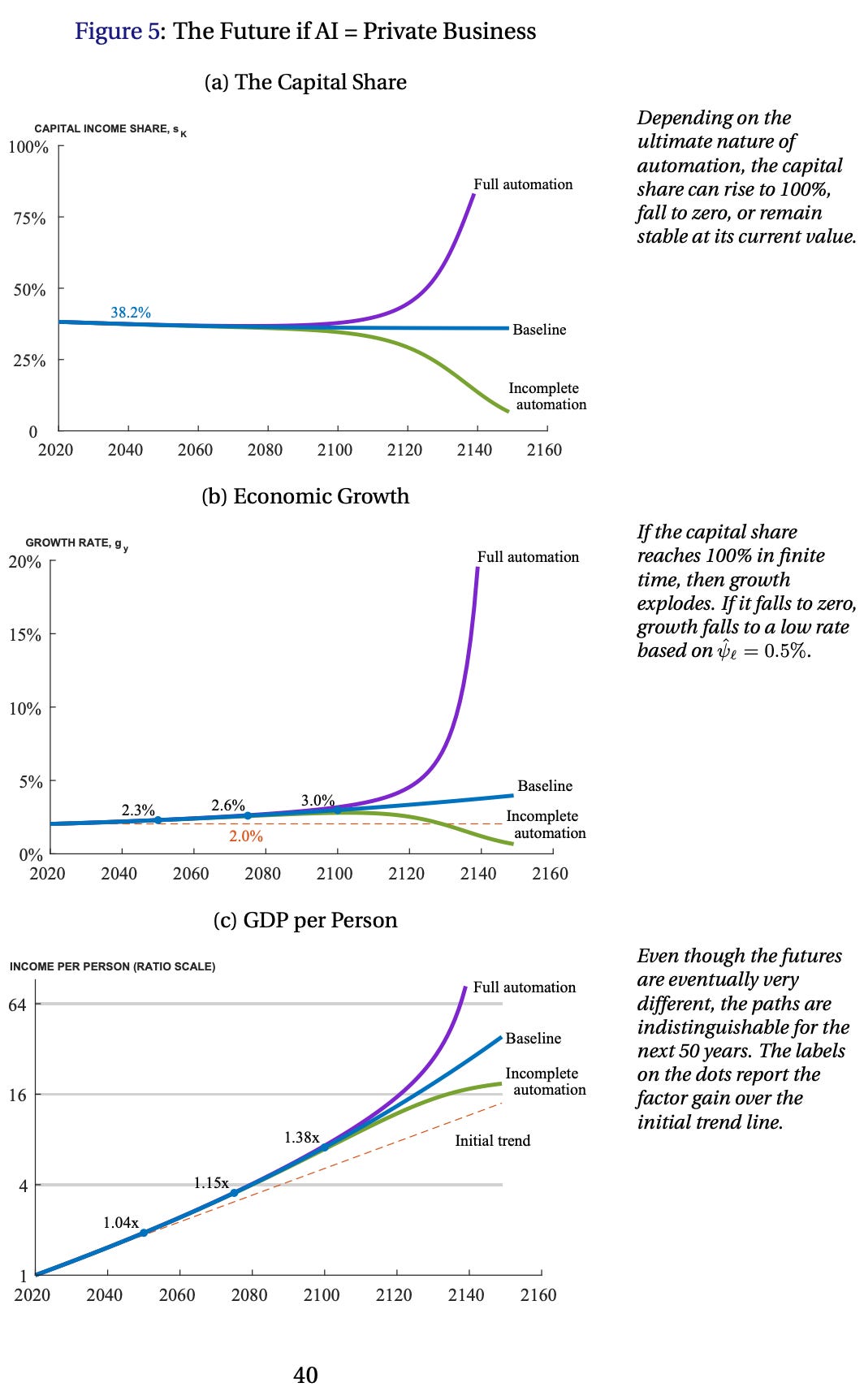
Weak links is an interesting modeling framework that posits that all links in a complex chain (from technology to product to sales), need to be automated in lock step for explosive supergrowth. Else, one of them will become the bottleneck and dampen overall growth.
For example, the impact of automating all software is only 2% of the GDP (which is a lot but nowhere enough to justify $Trillion valuations for a dozen companies).
But automating the rest of the economy is likely to be a long slog. Their base scenario shows that under reasonable assumptions full automation will take a century (2120-2140ish) and we’ll have barely faster growth.
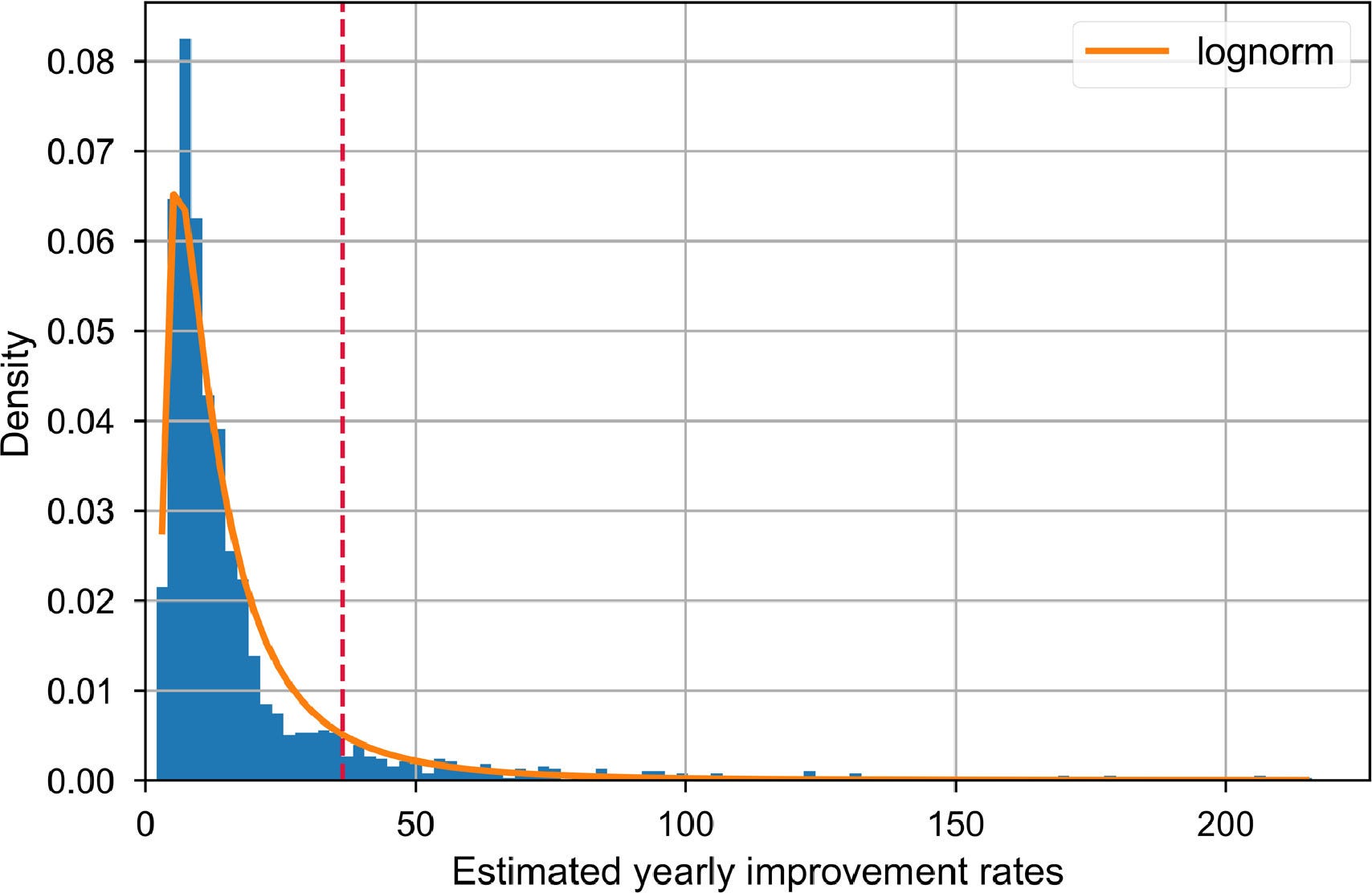
Even in their wildest scenario, labor effects don’t show up until 2045. That model assumes Moore’s law for all technologies and machines in the economy. Our 2021 paper (Singh, Triulzi and Magee) demonstrates that about 90% technological domains improve at a rate slower than Moore’s law. In fact, more than two-thirds of the domains are improving at a rate less than 15%. Thus, the wildest scenario is truly wild and unlikely to come to pass.
This framework builds on Nobel laureate Michael Kramer’s original O-ring model which tries to explain explains why developing countries tend to find it hard to produce extremely complex products. Essentially a single error in a highly complex chain can bring down the whole enterprise. This happened famously with a small O-ring in the Challenger Shuttle disaster (famously demonstrated by Richard Feynman on National TV).
On the one hand, this means we’ll still have jobs. On the other, it also means large growth effects are fairly far off in time and we are likely to grow rich slowly.
Just excellent work.


Sources:
1. https://web.stanford.edu/~chadj/JonesTonetti_Automation.pdf
2. Anuraag Singh, Giorgio Triulzi, Christopher L. Magee, Technological improvement rate predictions for all technologies: Use of patent data and an extended domain description, Research Policy, 2021, https://www.sciencedirect.com/science/article/pii/S0048733321000950
3. Chad Jones Youtube talk