
One of the interesting thing about technology progress is that there are often debates on hitting physical limits. It happens. We hit supersonic speed in commercial airliners and stopped improving basically. The speed-cost tradeoff was just not worth it. But airplanes have continued to improve in cost, comfort and safety.
Another example is LEDs. While it’s true that we might be close to maxing out the efficiency (lumens per watt) but we continue to get astounding decreases in cost. Literally light too cheap to meter.
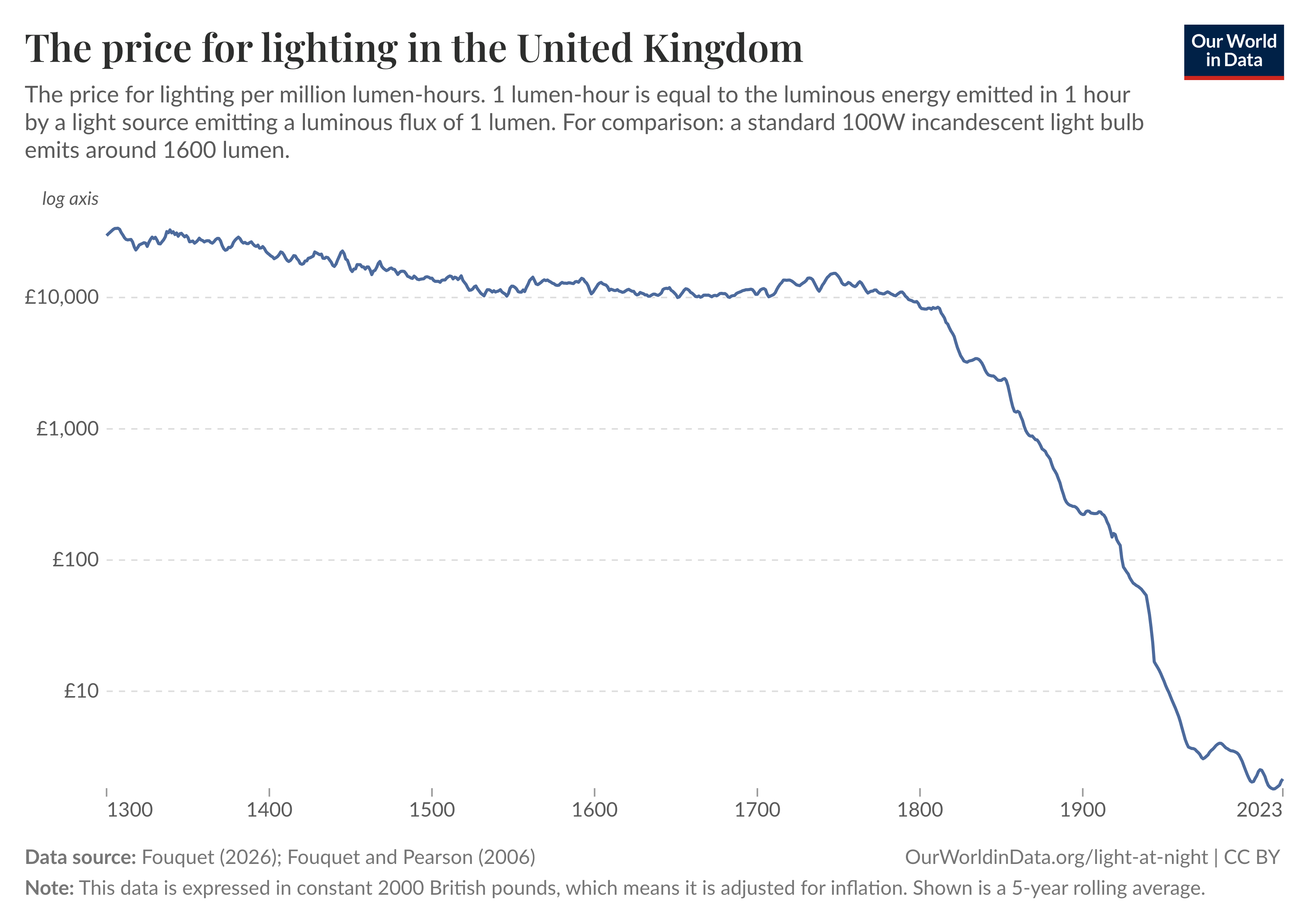
See the excellent article by our world in data and the original work by Fouquet (2026), just published in the, also excellent, handbook of energy innovation (See the cost curve above).
This is a general principle that has served us well in the long run. When pundits proclaimed the death of Moore’s law in early 2010s, it was easy to bet on the fact that technology will find a way. And it did, using EUV. This made possible the amazing leap in performance in M-series Macbooks, NVIDIA GPUs for LLMs and the latest iPhones).
There is similar pessimism in AI and that we’ll run out of new data or new compute or memory or energy. Each of these is a solvable (or already partly solved) problem. Few people realize that Google reduced the energy required for the median prompt by 33x just last year. There’s strategies for going around the data wall and we are going to see better memory architectures soon too.
Problems are just opportunities for progress. Technology progress is almost always a good bet to take. We should expect continuous progress in AI, Quantum computing (and every other technological field). I should also note that there is a wide gap between technology progress and the impact it actually has on the world. It takes years of work to make the smallest dent on GDP. It takes the talents of an entire society of scientists, engineers, entrepreneurs, designers, managers, janitors, salespeople, financiers, lawyers, regulators, to bring a technology to bear.
But it’s a good thing. Solving problems is fun and I think we’ll always have more problems than we can solve. The more we solve, the more problems we uncover. An infinite game!
Source: https://ourworldindata.org/data-insights/the-price-of-lighting-has-dropped-over-999-since-1700
Fouquet (2026) Ch 2: A historical perspective on energy innovation: energy transitions, efficiency improvements, rebound effects, and consumer welfare impacts. Roger Fouquet in Handbook of Energy Innovation https://www.elgaronline.com/edcollchap/book/9781035310418/chapter2.xml
https://www.technologyreview.com/2025/08/21/1122288/google-gemini-ai-energy/
P.S. Do check out the Handbook of Energy Innovation. Two of my favorite people were part of the excellent team that put it together.